
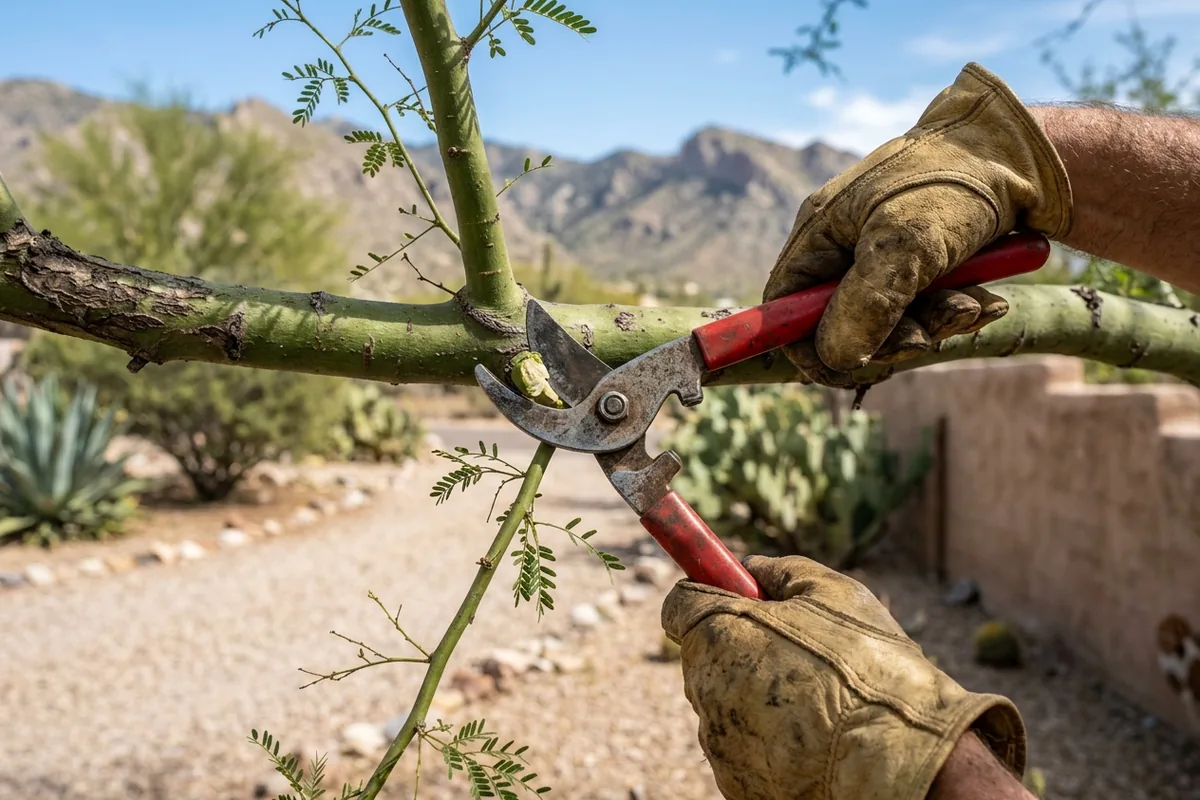
When to Prune Trees in Tucson: A Tree-by-Tree Calendar
The short answer: In Tucson, the right pruning season depends on the kind of tree. Desert trees such as palo verde, palo brea, Texas ebony and sweet acacia should be pruned in warm weather, from late spring through summer, because cuts made in cold weather heal slowly and can cause dieback. Deciduous shade and fruit trees such as Arizona ash, Chinese elm and fruit trees are best pruned in winter while they are dormant, usually from mid-December to mid-January. Dead, broken or hazardous limbs can come off at any time of year.
October sits between those windows. It is a month to plan pruning, not to do major cuts. Below is a tree-by-tree calendar for the trees most common in Tucson yards, followed by what to do this fall, how much to cut and when to bring in a certified arborist.
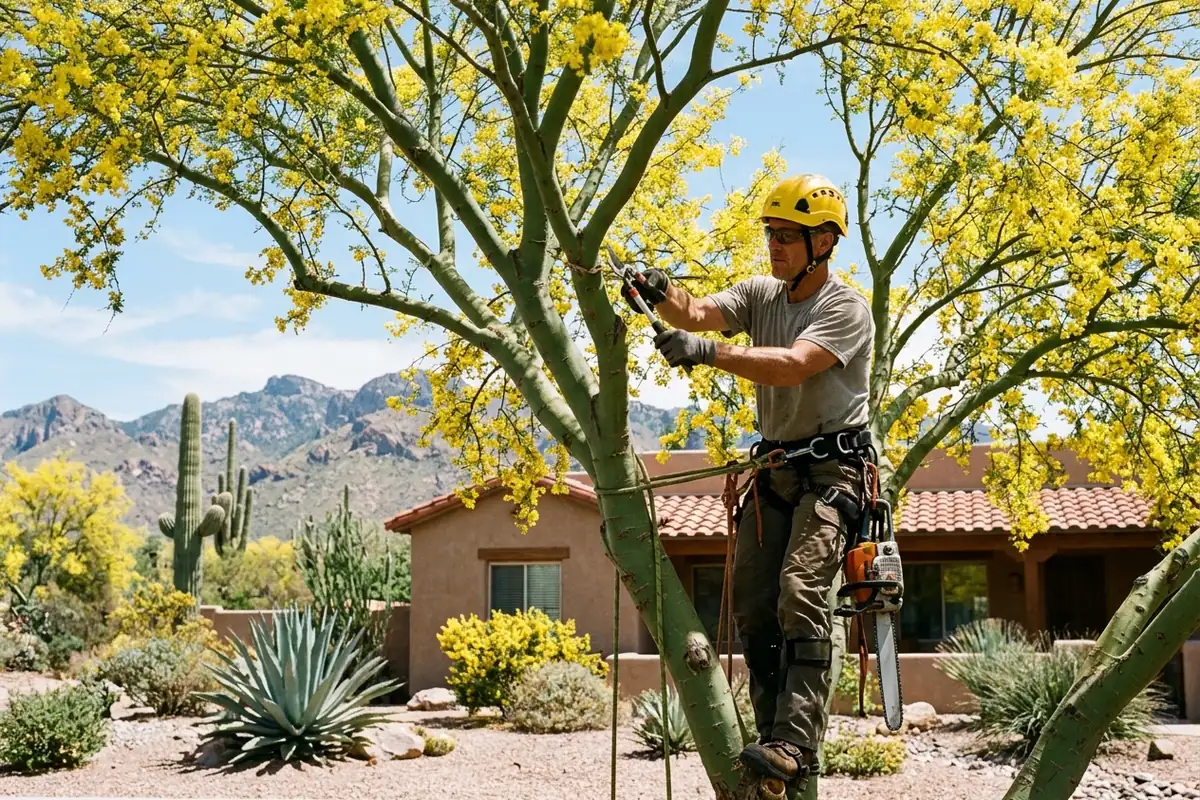
Tucson tree pruning calendar at a glance
The timing below comes from the pruning notes for each species among the trees in our plant guide, along with University of Arizona Cooperative Extension guidance for the low desert. Use it for routine and structural pruning. Safety cuts on dead or broken branches don't need to wait.
| Tree | Best time to prune | What to keep in mind |
|---|---|---|
| Blue palo verde | Warm weather only | Cold-weather cuts can cause limb dieback and infection |
| Desert Museum palo verde | Warm weather | Prune to keep an upright form; don't overwater a fast grower |
| Palo brea | Warm weather | Cold-weather pruning encourages bacterial infections |
| Velvet mesquite | Late summer | Spring pruning causes rampant growth |
| Honey mesquite | Dormant season | Stake and train young trees for a sturdy trunk |
| Chilean mesquite | Late fall | Raise and thin the canopy; remove suckers and water sprouts |
| Texas ebony | Early summer | Raise the canopy a few side branches at a time; sharp spines |
| Sweet acacia | Late spring to early summer | Young trees need substantial shaping |
| Willow acacia | Fall or early spring | Thin the canopy to reduce wind resistance |
| Desert willow | Spring, as leaves emerge | Remove winter damage; seedpods can come off any time |
| Arizona ash | Winter dormancy (mid-December to mid-January) | Careful branch selection builds a strong structure |
| Chinese elm | Winter, after its late-December leaf drop | Minor pruning for clearance and structure; remove suckers |
| Deciduous fruit trees | January, while dormant | Finish before spring buds swell |
| Crape myrtle | Late winter | Remove old seedpods, dried blooms and base suckers |
| Jacaranda | Spring | Wait until spring to cut frost-damaged limbs |
| Citrus | Only when needed | Prune only broken branches or limbs blocking a path |
| Palms | Any time, lightly | Remove only dead or dying fronds |
Desert trees: prune in warm weather
Most of Tucson's native and desert-adapted trees heal fastest when it is hot. University of Arizona Cooperative Extension's July gardening guide for Pima County says mesquite and palo verde can be pruned in midsummer because they heal quickly in the heat, and that some sap loss from pruning will not harm the tree.
- Palo verde: Blue palo verde should be pruned only in warm weather. Cold-weather cuts can make limbs die back and may let infection in. Young trees need substantial pruning to develop a canopy you can walk under. The thornless Desert Museum palo verde grows fast, so prune it to keep a strong, upright shape.
- Palo brea: Palo brea has a wide, irregular crown and needs more pruning than most desert trees. Remove dead limbs and crossing branches in warm weather, because cold-weather pruning encourages bacterial infections.
- Texas ebony: Its natural canopy grows all the way to the ground. Prune Texas ebony in early summer, taking only a few side branches each time until the crown is as high as you want it. Wear protective clothing, because the spines are very sharp.
- Sweet acacia: Young sweet acacia trees grow like multi-trunked shrubs and need substantial shaping. Prune in late spring or early summer to remove damaged limbs and shape the tree.
- Velvet mesquite: Thin, shape or raise the canopy of velvet mesquite in late summer. Pruning it in spring causes rampant growth.
Warm-season pruning also lines up with storm prep. Removing dead, weak or crowded branches before summer storms lowers the chance of limbs breaking. Our guide to storm-proofing trees before monsoon winds covers what to check.
Deciduous shade and fruit trees: prune in winter dormancy
Trees that drop their leaves for winter are easiest to prune once they are bare. University of Arizona plant scientist Ursula Schuch's Pruning Trees and Shrubs presentation lists winter dormancy as the time for deciduous trees and summer for native trees. In Tucson, dormancy pruning usually runs from mid-December to mid-January, well before spring buds swell. With the leaves gone, crossing limbs and crowded branches are much easier to see.
- Arizona ash: Arizona ash grows fast. Careful pruning and branch selection while it is young give it a strong trunk and stable limbs.
- Chinese elm: Chinese elm is semi-deciduous in Tucson and drops its leaves in late December. It needs only minor pruning for clearance under the canopy and a strong structure, plus removal of suckers that sprout elsewhere in the yard.
- Fruit trees: UA Extension's January gardening guide says to trim deciduous fruit trees and shrubs that month while they are dormant.
- Crape myrtle: In late winter, cut off old seedpods, dried blooms and any suckers growing from the base of crape myrtle.
The exceptions worth knowing
A few common trees don't fit the two main groups:
- Desert willow: Despite being deciduous, desert willow is pruned in spring, just as its leaves emerge, so you can see and remove any winter damage. To keep a single trunk, remove only the lowest limbs each spring until the tree reaches the height you want.
- Willow acacia: Prune willow acacia in fall or early spring to raise and thin the canopy. Regular thinning reduces wind resistance.
- Mesquite varieties differ: Our plant guide lists late summer for velvet mesquite, the dormant season for honey mesquite and late fall for mature Chilean mesquite. If you are not sure which mesquite you have, have it identified before you cut.
- Citrus: UA Extension advises not pruning citrus unless branches are broken or in the way of a path.
- Palms: Remove only dead or dying fronds. Cutting green fronds stresses the palm.
What to do (and not do) this fall
UA Extension's October gardening guide for Pima County says not to do major pruning on trees or shrubs in October unless a plant is very leggy, unsafe or blocking a walkway. It also warns that frost is possible late in the month. Here is what that means for your yard:
- Hold off on big cuts. Save structural pruning for each tree's season in the calendar above.
- Take care of safety right away. Dead, broken or hanging limbs, and branches over walkways, driveways or the roof can be removed any time.
- Make a list for winter. Note which deciduous trees need structural work in the December-to-January window, and which desert trees should wait until late spring.
- Leave frost-damaged limbs alone. If a freeze browns your trees this winter, wait until mid-March to prune. Frozen branches still protect the rest of the plant, and new growth will show what is alive. Our frost damage prevention and treatment tips explain what to look for.
- Have frost cloth ready. Young or frost-tender trees, such as jacaranda, may need covering on cold nights.
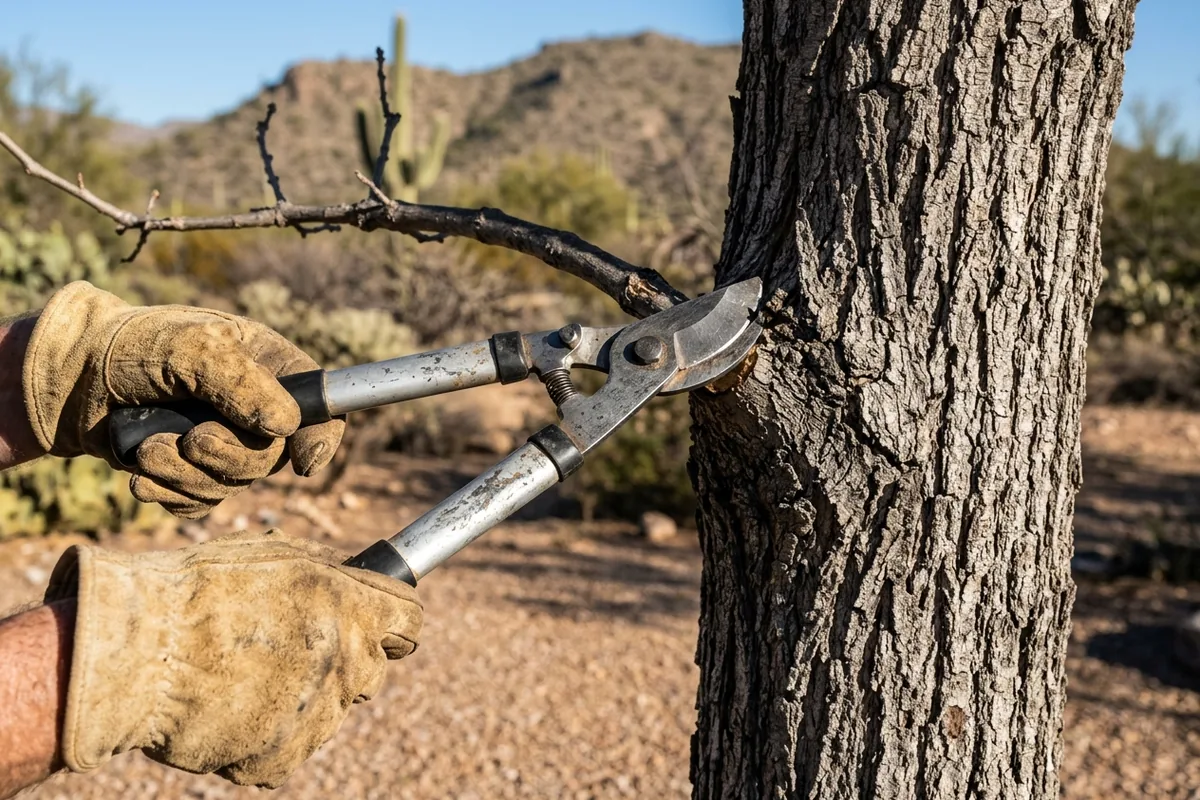
How much to cut and how to cut it
Good timing doesn't help if the cuts are wrong. These rules come from University of Arizona guidance and the tree care practices on our tree services page:
- Never remove more than about a quarter of the canopy at one time. The remaining leaves feed the tree.
- Size up the cut first. If a branch is under 2 inches across, go ahead. Between 2 and 4 inches, think twice. Over 4 inches, have a good reason.
- When raising a canopy, keep live branches on at least two-thirds of the tree's height. Stripping too many lower limbs weakens the trunk.
- Cut just outside the branch collar, the slight bulge where a branch joins the trunk, and never leave a stub.
- Use three cuts for heavy branches: an undercut, a second cut slightly farther out to drop the weight, then a final cut at the collar. This keeps the bark from tearing.
- Skip the pruning paint. UA Extension advises against putting sealer on pruning cuts. Let them close naturally.
- Don't top trees or lion-tail them. Topping removes too much foliage, ruins the tree's structure and produces weakly attached new branches. Lion-tailing, which strips the inner branches and leaves foliage only at the tips, makes limbs more likely to break.
If a tree has to be cut back hard every year to fit its space, it is probably the wrong tree for that spot. Before replacing one, compare Tucson shade trees by mature size, water needs and litter.
When to call a certified arborist
Small trees and low branches you can reach from the ground are fair game for a careful homeowner. Call a professional when:
- The work requires climbing, a ladder or a lift, or a chainsaw.
- Branches are near power lines. Never prune a tree that touches utility lines; contact the utility or a certified arborist.
- A large limb is cracked, hanging or leaning over a roof, pool or walkway.
- A young tree needs structural training, such as choosing a central leader and spacing scaffold branches.
- You are not sure what the tree is or when it should be pruned.
Our certified arborists provide tree pruning service in Tucson for homes and commercial properties. Pruning can also be built into a landscape maintenance plan, so desert trees get attention in warm weather and deciduous trees get theirs in winter.
Frequently asked questions
What month should I prune trees in Tucson?
It depends on the tree. Prune deciduous trees such as Arizona ash, Chinese elm and fruit trees from mid-December to mid-January while they are dormant. Prune desert trees such as palo verde, palo brea, Texas ebony and sweet acacia in warm weather, from late spring through summer.
Can I prune my palo verde in winter?
It is better not to. Our plant guide says blue palo verde should be pruned only in warm weather, because cold-weather cuts can cause limbs to die back and may introduce infection. Remove broken limbs if they are a hazard, and save shaping for late spring or summer.
Should I prune trees in October in Tucson?
Only lightly. University of Arizona Cooperative Extension advises against major pruning in October unless a tree is unsafe, very leggy or blocking a walkway. Remove dead or broken branches, then plan structural work for winter or the next warm season.
How much of a tree can I cut off at once?
No more than about a quarter of the canopy at one time. The leaves that remain make the food the tree needs to stay healthy, so removing more weakens it.
Do I need to seal pruning cuts?
No. Wound dressings and pruning paint don't speed healing or prevent decay. A clean cut just outside the branch collar closes best on its own.
Tree trimming & pruning in Tucson
Get your trees on the right pruning schedule
Not sure which trees to prune this winter and which to leave until summer? Our certified arborists look at each tree, tell you what it needs and when, and do the work safely.
- Free quotes
- Tucson landscapers since 1979
- Residential & commercial